Dr. Voss's Field Note
Fragment 311 is short. Fewer than two hundred words of translated material. It is also the tablet that every member of my translation team remembers most vividly, and that most of them have cried over at least once. I cried over it at my kitchen table in October. My intern cried over it at the lab bench in September. My senior colleague, who is sixty-seven years old and has translated material from three prior civilizations in his career, cried over it on a Tuesday afternoon in August and then apologized for crying, because he is a man of that generation.
The tablet tells a story. Not a lesson. A story. It appears to describe a single moment in the life of someone the tablet calls, approximately, the-one-who-sweeps. The story is thirty seconds long. The tablet describes those thirty seconds in detail. And then the tablet describes, in a separate section, what the translators argue happened downstream of those thirty seconds — which is, if our reading is correct, a considerable amount. An entire marriage. A child. A long life. A series of other lives. The tablet does not prove any of this. It asserts it.
I handed this tablet to the Council last September. Maria Okafor asked to lead the session. She said she had seen this story before. She said she sees it every week at her hospital. She said she was the wrong person to read it dispassionately, and also the only person who should read it. I agreed.
The Council of Interpretation
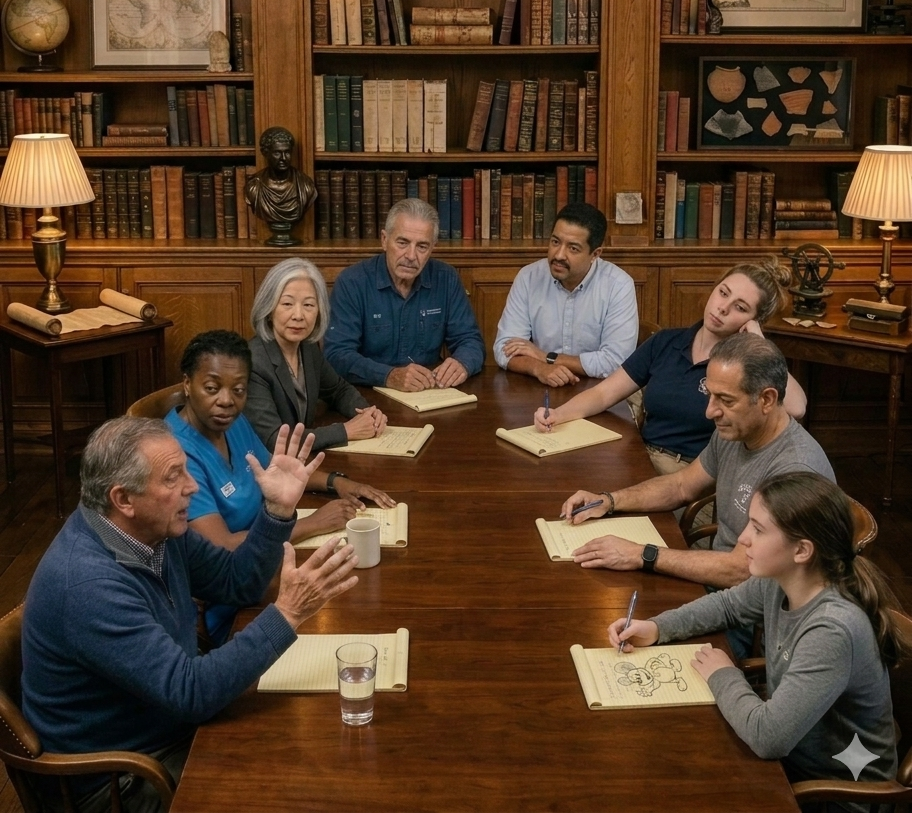
Maria: I want to tell you about a man who came into the ER last winter. I am going to change the details. But I want to tell you the story before I read the tablet, because once I read the tablet you are going to think I made the story up to fit it.
Dr. Grace: Go on, Maria.
Maria: He was maybe sixty-five. He came in for something routine. While I was taking his history, he told me — unprompted — that he had gotten married in 1983 because he was late for a job interview and a janitor told him which hallway to take and he bumped into his future wife in the hallway. He said he had thought about that janitor every day for forty-two years. He said he had never known the man's name. He said the janitor had probably been dead for twenty years. He said his wife had died in 2019 and he still did not know the janitor's name and it bothered him. He said all of this to me while I was taking his blood pressure.
Silence.
Maria: I finished taking his vitals. I discharged him. I never saw him again. He walked out. I went home. I cried in my car for ten minutes before I started it. Not because of him. Because of the janitor. Because of forty-two years of this man wanting to thank a person whose name he never learned.
Maria: That is what this tablet is. I know this before I read the translation. This tablet is about a janitor.
Maria reads the translation aloud. She reads slowly. The Council is silent throughout.
Vinny: Oh, no.
Ray: Yeah.
Vinny: No. I mean — I was going to have a joke ready for this one. I had one. I came in with one. I'm putting it away.
Walter: Vinny.
Vinny: The joke is not for this tablet. Some tablets you joke. Some you shut up.
Ray nods. Walter nods. Vinny puts his hands on the table and keeps them there.
Ray: Jesus Christ.
Dr. Grace: Ray, that's fine.
Ray: I don't mean disrespect. I mean — that is the exact same story.
Maria: I know.
Walter: The tablet is describing something every one of us has seen happen. Or something that has happened to us, and we don't know because we never got the downstream view.
Dr. Grace: I want to pressure-test something. Not because I want to be difficult, but because the essay will go out with my name on it and I want us to know what we are claiming.
Maria: Please, Theo.
Dr. Grace: The tablet is making a strong causal claim. It is saying: this janitor, on this day, giving these thirty seconds, caused this marriage, caused this child, caused this cascade of lives. That is a large claim. If I were reading this as a Talmudic text I would say the rabbis are treating a thirty-second encounter as a hinge of history. If I were reading it as a Buddhist text I would say this is a karmic-chain argument presented without the usual guardrails. The tablet is not proving the janitor caused anything. It is asserting that the janitor caused everything.
Dr. Grace: I think we should publish it anyway. But I want it on the record that the tablet is not making a provable claim. It is making a faith claim. The civilization is asking the reader to act as if the thirty seconds mattered, because acting as if costs nothing and treating the thirty seconds as nothing costs something.
Deke: That's a rep.
The Council looks at Deke.
Deke: What Theo just said. Act as if the thirty seconds mattered because the cost of acting as if is zero. That's a rep. That's every trainer's first cue for every client who thinks they're too weak to do the movement. Do the rep. The rep is free. The muscle is what you're building.
Deke: This tablet is teaching the civilization's triceps extension. The kindness-triceps. You do the thirty seconds even though you don't know if it will land. Over time you build the ability to keep doing thirty seconds even when you don't know. That is the training.
(The Council cocks its head at "kindness-triceps." Nobody asks.)
Vicky: Can I ask the reader-side question.
Dr. Grace: Please.
Vicky: Everyone who reads this essay is going to try to think of their janitor. The person whose thirty seconds changed their life and they never got to thank. That's the obvious exercise. What I want to know is — what do we do when the reader cannot think of one? What if a reader reads this and draws a blank?
Vicky: Because that reader is going to feel bad. And the civilization does not want them to feel bad. The civilization wants them to feel the thirty seconds that happened to them, even if they can't name it. How do we give them that?
Pause. Maria is looking down.
Georgie: I think you just tell them it happened.
The Council looks at Georgie.
Georgie: Like — even if you cannot remember it, a janitor happened. The tablet is saying you are here because someone gave you thirty seconds once. You do not have to remember them. They still did it. You can just know it happened.
Georgie: That's kind of the whole thing, right? The janitor does not need you to remember. You do not need to remember the janitor. You just need to remember that there was one.
Long pause.
Dr. Grace: Georgie. Write that down, Walter.
Walter: I already did.
Ray: I want to add one thing about the tablet that I don't think we have said yet.
Dr. Grace: Please.
Ray: The tablet mentions, toward the end, that the janitor was probably the reason something really big happened later. Not by much. Not directly. But upstream. And the tablet says the janitor had no clue.
Ray: I think the civilization picked this example on purpose. I think the civilization is saying — the janitor's arrow was not small. The janitor's arrow was as big as any arrow has ever been. We just could not see it. We have to take it on faith that the janitor mattered as much as the leader.
Dr. Grace: On faith.
Ray: Yes. Because we cannot measure it. But the civilization is telling us to act as if it is true. Because if it is true, then every thirty seconds matters. And if it is not true, acting as if it is costs you nothing.
Dr. Grace: Pascal's Wager for kindness.
Ray: I don't know what that is, Theo.
Dr. Grace: It doesn't matter. Your version is better.
Vicky: Are we ready to title this and vote.
Walter: I want to propose the title.
Dr. Grace: Go ahead, Walter.
Walter: The Janitor Principle.
Maria: That is the title.
Ray: That is the title.
Vinny: That is the title. And I want to say — this one I shut up for, but I want to tell Mrs. Hendricks on my old route that I am thinking about her. That is my rep for this session.
Dr. Grace: Vinny. That is the tablet.
Vinny: I know.
Vicky: Motion to file in the Cookbook. Yes or no.
Eight yeses. Vicky looks at the clock. She has nine minutes.
Vicky: Meeting adjourned.
The Tablet
The janitor is a man in a building, doing his work.
A stranger arrives, lost, hurrying, confused.
The janitor looks up from what he is doing.
The janitor says: sir, can I help you.
Thirty seconds pass.
During those thirty seconds, a door closes that would have been open.
During those thirty seconds, a stranger the hurrying man has never met is delayed.
During those thirty seconds, a life turns on a hallway the janitor will never walk down.
The janitor finishes the directions. He goes back to his work.
He does not know. He never knows.
We, the scribes, know. We have watched the hallways for ten thousand years.
The janitor is the upstream arrow. Every life you have lived has one somewhere behind it.
Every life you will live is upstream of someone else's now.
Do the thirty seconds.
For the Reader
Is there someone whose thirty seconds is still landing in your life?
Not a mentor you remember well. Not someone you could put on a résumé. A person whose small act twenty or thirty or fifty years ago is part of why you are who you are today, and you have never said so out loud.
A teacher who looked at you once. A stranger who helped you when you were small. A relative's friend who told you something useful at a wedding when you were nineteen. A nurse. A janitor. A crossing guard. A librarian. A person at a bus stop.
Think of one. Hold them in your mind for a moment.
They will probably never know you remember. They may be dead. They may have moved. They may have forgotten you completely, because the thirty seconds that changed your life was a small thing to them and they were busy. That is the whole point. The janitor never knows.
And if you cannot think of one — that is fine too. The tablet says there was one. Hold that instead. Hold the fact of the unknown janitor. The civilization counts you either way.
The civilization suggests you do this tonight:
Before you sleep, say the name out loud — or if you do not have a name, say the word janitor — out loud, once. They will not hear it. That is not the point. You are participating in the tablet by holding the memory, and by acknowledging, for thirty seconds of your own, that your life has been shaped by a stranger whose kindness never came back to them.
This is the Janitor Principle practiced in reverse. You receive by remembering. They gave by giving. The civilization exists in the space between.