Dr. Voss's Field Note
Fragment 102 was the second tablet my team recovered from the Western Chamber. It is a short tablet — fewer than three hundred words translated — and for three months I misread what it was.
My first reading took the tablet as a kind of preface. An authorial humility gesture. The scribe saying, in effect, I did not invent these teachings; I am merely writing them down. A disclaimer. Standard throat-clearing for the start of a body of work.
I thought for weeks I was mistranslating.
Then I stopped and looked at what the tablet actually said. It is not a disclaimer. It is a structural claim. The tablet says, in the plainest terms I can render: every teaching we hand you came from somewhere. We did not invent any of this. We are writing it down. The writing is ours. The wisdom is not.
I gave Fragment 102 to the Council and told them I thought it was the civilization's founding statement about authorship. Ray Mendez read it and told me, immediately, what it was. I had not seen it until he said it.
The Council of Interpretation
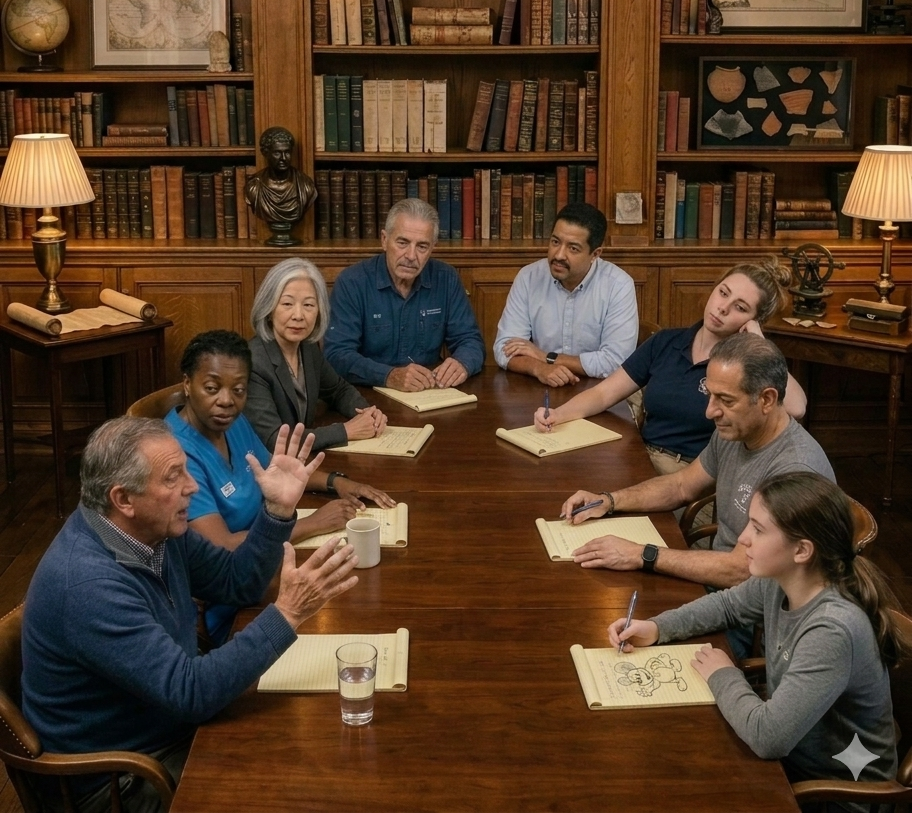
Vinny: Alright, alright. Before anybody goes academic on me. I'll tell you what this tablet is. This tablet is about my uncle Carmine, who used to say — every Thanksgiving — that the cranberry sauce was a family recipe. It was from the back of a can. Everybody knew it was from the back of a can. He would still pick up the spoon and say, this is from my grandmother in Calabria. For forty years. That is what this tablet is.
(general groaning)
Walter: Vinny.
Vinny: What.
Walter: You just told us the tablet is about your uncle lying about cranberry sauce for forty years.
Vinny: I said what I said.
(light laughter. Vicky glances at her phone. Georgie is quietly smiling.)
Ray: It's a recipe disclaimer.
The room goes quiet. Theo looks up.
Dr. Grace: Ray. Say that again.
Ray: It's a recipe disclaimer. Every cookbook my wife ever owned had something like this on the first page. A little note from the author saying, I did not invent any of these recipes, I learned them from my grandmother and from church ladies and from neighbors, and I am just the one who wrote them down. Every good cookbook has that note. The bad cookbooks leave it off and pretend the recipes are theirs.
Walter: Ray, I think you just cracked the whole thing.
Ray: I did not crack it. The tablet is just telling us what it is.
Maria: Say more about the cookbook note. I want to understand.
Ray: Sure. My wife had a book from her mother, and inside the front cover her mother had written, in pencil: "I did not make any of this up. Mrs. Orlinski taught me the rolls, Aunt Marguerite taught me the pies, the soup is from Marge down the road who is not even related to us, and the thing we call Mama's chicken is actually from a woman Mama worked with at the hospital in 1962 and Mama never even knew her last name." That note was on the inside cover of the cookbook. And Mama's chicken is in the book with Mama's name on it.
Ray: That is what the tablet is doing. Someone sat down and said, before we carve these teachings into stone, let us put on the front page that we did not invent any of this. We are the ones writing it down. The wisdom was always the people's.
Long pause. Vinny is nodding slowly. His joke has evaporated. Everyone can see he has already understood where this is going.
Vinny: That is exactly what my uncle was doing. With the cranberry sauce.
Vicky: Was he.
Vinny: No. He was lying. But I think now — thinking about it — his grandmother in Calabria probably did have a cranberry recipe. Or something close. And when he said it was hers, he was doing what Ray is saying. He was giving her the credit. He just had the wrong recipe.
Dr. Grace: Vinny. That is the tablet. That is exactly the tablet.
Vinny: I know.
(Vicky looks up from her phone. Something has shifted in the room.)
Dr. Grace: I want to push on something. In my field we take this kind of statement very seriously. Every tradition I have ever read has some version of an attribution practice. The Talmud cites its rabbis by name. The Greek philosophical schools cited their predecessors. The Buddhists cite the sutras. The Sufis cite the masters. Attribution is deep ethical practice across every major tradition I have studied.
Dr. Grace: But what the tablet is doing is different. The tablet is not citing rabbis. It is not citing prior scribes. It is not even citing the named dead. It is citing the unnamed.
Ray: It is citing the people.
Dr. Grace: Yes. The people. That is the distinction. I have spent forty years reading attribution traditions across world religions and none of them, not one, cites the anonymous village. They cite their named fathers. The tablet cites its unnamed grandmothers.
(silence)
Dr. Grace: Ray. The tablet is doing something none of the traditions I have studied have done. I want that on the record.
Ray: Put it on the record.
Maria: I want to add something. Because I think Ray is right and Theo is right and it matters that both of them are right.
Maria: In the emergency room, when a patient comes in with a specific kind of wound, I can tell you which attending taught the resident who taught me. I can name that lineage back three generations. That is how we do it in medicine. Attribution.
Maria: But the things that actually keep people alive in the ER — the ability to stay calm, to listen to a patient who is scared, to notice that a heart rhythm is wrong before the monitor does — those I learned from nurses whose names I do not remember. Nurses I worked one shift with. Nurses who taught me in ten minutes by the way they held a patient's hand. I could not cite them if my license depended on it. And everything I do for a patient now is made out of them.
Maria: That is who the tablet is talking about. Not the attending. The nurse I cannot name.
Deke: Every trainer I have ever respected stole their best cues. I stole mine. You watch a better coach run a warm-up and you notice that the way she talks to the tight hip flexor is not the way you would talk to it, and you take that home, and you use it on Monday.
Deke: I have been using a cue for the posterior chain for fifteen years that I got from a guy in Toledo in 2010 whose name I never learned. He said one sentence to me between sets. I have used that sentence on a thousand clients. He does not know. I could not find him if I tried.
Deke: That is a lineage. Nobody wrote it down. My glutes-and-hamstrings practice is a lineage that runs through a man in Toledo.
(The Council cocks its head at "posterior chain." Nobody asks.)
Vicky: Theo. Hold on. Can I ask the question.
Dr. Grace: Please.
Vicky: The tablet is a disclaimer. Fine. Ray said it, we all agree, let's move. But what does the reader do with it.
Vicky: I mean — I do not write books. Most people do not write books. If the tablet is for all of us, not just the scribes, then what is the tablet telling the rest of us to do.
Long pause. Everyone turns to look at Georgie, who has been quiet.
Georgie: Is it just — like — thank the people you learned from. Even if they are dead. Even if you do not remember them.
(silence)
Walter: Yes.
Ray: Yes.
Dr. Grace: Forty years of reading this literature. Georgie just said it in one sentence.
Georgie: I was just asking.
(Vicky glances at the time. Forty-three minutes in. She is leaning back.)
Vicky: So the tablet is a disclaimer, and the reader's assignment is to credit the people they learned from, and we've been landing on this for ten minutes. Are we ready to vote it into the Cookbook.
Walter: I think we are.
Maria: Agreed.
Deke: Yes.
Vinny: Yeah. And I want to revise my cranberry-sauce testimony.
(laughter)
Dr. Grace: I want to add one thing before we vote.
Dr. Grace: This tablet is the civilization's statement about itself. The civilization is not claiming to invent kindness. The civilization is claiming to have been paying attention for eleven thousand years and to be writing down what it saw. I think this tablet should not just go into the Cookbook. I think it should go to the Hill for ratification.
Ray: That was going to be my next sentence.
Vicky: Okay. Motion on the floor. Cookbook entry plus Hill recommendation. Yes or no.
Eight yeses. The motion carries. Vicky looks at the clock. She has seventeen minutes to catch her bus.
Vicky: Meeting adjourned.
The Tablet
Before these teachings, a preface.
We did not invent any of what follows.
The teachings came from the people who practiced them, long before any of us could write.
From the grandmother who fed her neighbor's child without being asked.
From the stranger who paused at a fire to help a stranger.
From the one who swept the floor and left the door unlocked for the next person who needed shelter.
They did not sign their work. They did not need to.
We are the scribes. We wrote this down.
The wisdom was always the people's.
Thank the people you cannot name.
For the Reader
The Council asks one question of every reader who finishes this essay.
Not the big dramatic answer — not your best mentor, not your mother on her deathbed, not the pastor who changed your life. Those people are important and you already remember them.
The harder answer. Who is the person you never thanked, whose kindness to you on a Tuesday twenty years ago is part of why you are able to be kind to someone else next Tuesday? Who is in your hands when your hands do a kind thing? Can you name five of them?
The civilization is asking because the civilization is asking. The civilization is made of the unnamed. If you can name even one person who taught you something unowed — a neighbor who did one thing for you once, a teacher who looked at you with real attention in sixth grade, a stranger who stopped to help when nobody else did — then you are already a citizen, and the civilization already has your enrollment.
If you can name five, the civilization suggests you write their names down tonight, on paper, somewhere you will find them again.
They wrote you. It is fair to write them back. Even if they will never read it. Even if they are dead. Even if you do not remember their last names.
This is how the Cookbook stays alive.